1
Arrange your hidden army
Choose a starter formation, shuffle it, or edit the ranks one square at a time. Your Flag and Bombs stay in place, while every other piece can move. Protect the Flag without blocking every path out of your back rows.
A classic battle of hidden strategy
Command a hidden army, guard your Flag, and outthink a beginner opponent. Set up all 40 pieces, then play the classic Stratego board game right in your browser.
Your next move starts here
Less guessing. Better moves.
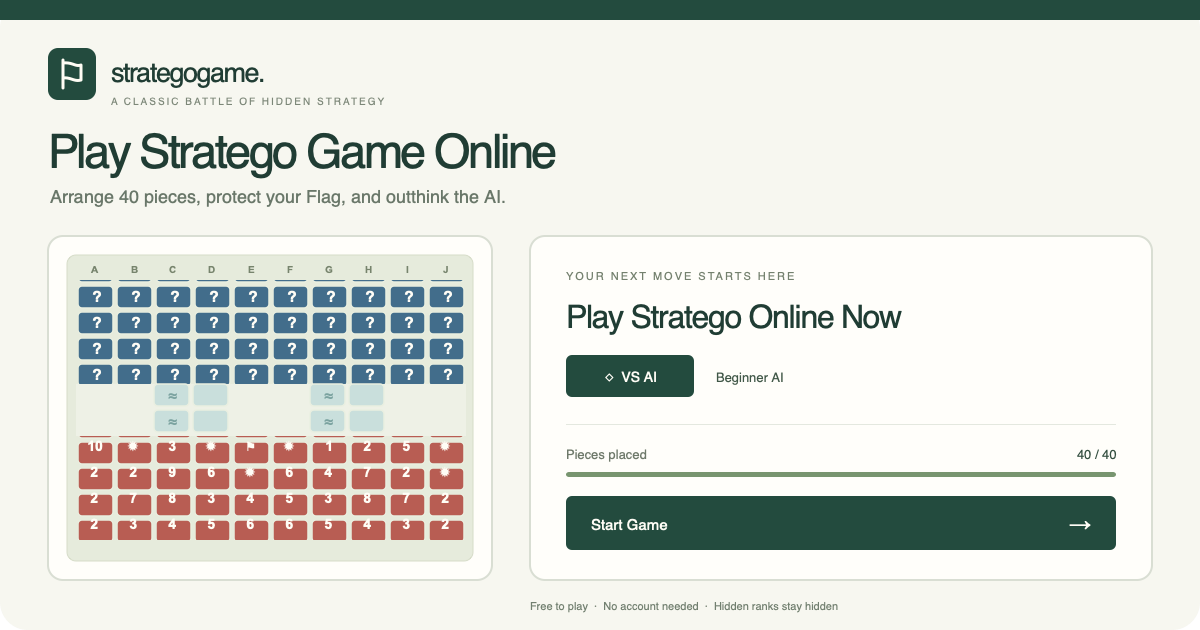
Your mission is to find the enemy Flag before your opponent finds yours. Each side commands 40 pieces on a 10-by-10 board. The four rows at each end are the home zones; the two rows of lakes in the middle split the battlefield into narrow routes.
1
Choose a starter formation, shuffle it, or edit the ranks one square at a time. Your Flag and Bombs stay in place, while every other piece can move. Protect the Flag without blocking every path out of your back rows.
2
Select a red piece and then an empty highlighted square, or select an adjacent enemy to attack. Most pieces move one square up, down, left, or right. Scouts can travel farther along a clear straight line. No piece can move diagonally, jump another piece, or cross a lake.
3
When a piece attacks, both ranks are revealed for that battle. The higher rank survives; equal ranks remove both pieces. A Miner defeats a Bomb, and a Spy defeats the Marshal only when the Spy starts the attack. Capture the Flag to finish the game.
The essentials to remember
Every army has the same 40-piece inventory. Ranks are numbered from Spy 1 through Marshal 10, with Bombs and the Flag as immovable pieces. Higher numbers beat lower numbers in a normal attack, but the special interactions below matter more than raw rank.
| Piece | Rank | Count | Rule to remember |
|---|---|---|---|
| Marshal | 10 | 1 | The strongest rank. An attacking Spy is the only piece that defeats it. |
| General | 9 | 1 | Other officers, strongest first |
| Scout | 2 | 8 | Moves any clear straight-line distance, but cannot pass through a piece or a lake. |
| Miner | 3 | 5 | The only piece that survives an attack on a Bomb. Keep some near likely traps. |
| Spy | 1 | 1 | Beats the Marshal only when the Spy attacks. It loses in every ordinary fight. |
| Bomb | — | 6 | Cannot move. A Miner can defuse it; other attackers are defeated. |
| Flag | — | 1 | Cannot move. Capture the opposing Flag to win the game. |
A formation with a reason
A strong opening makes your opponent spend turns learning your formation. Keep the Flag in a protected back-row pocket, then place Bombs where they guard likely approach lanes. Avoid surrounding the Flag with a wall that also traps your own mobile pieces. Leave at least one route open toward the center so your army can contest Scouts and pressure the lakes.
Do not send every Scout forward at once. Their long movement is excellent for checking empty lanes and discovering a hidden defender, but a Scout is weak in combat. Save Miners to clear Bombs near a suspected Flag, and use middle ranks to trade for information before risking your General or Marshal. A Spy is most useful when it stays unexposed until the Marshal is a believable target.
The starter formation is a practice pattern, not a guaranteed winning layout. Shuffle it to see how the same ranks feel in different positions, or edit it to test one idea at a time. After a game, ask which piece was exposed too early, which lane became blocked, and whether the Flag had enough protection without sacrificing mobility.
Practice on the board
Use the ready-made formation, shuffle your army, or place each Flag, Bomb, Spy, Scout, Miner, and officer yourself. The piece counter shows how many ranks remain in reserve.
The blue army starts concealed. The computer does not use your unexposed ranks to pick its moves; it learns about a piece only after that piece takes part in a battle.
Highlighted squares show legal moves, including the Scout’s long straight routes. The move counter and recent battle coordinates help you review how the board changed.
A thoughtful break, at your pace
New players can start with a balanced formation and discover rank interactions in a short practice game. The quick guide stays next to the board when you need a reminder.
Move Bombs, Flag, Scouts, or Miners into a different pattern and see how it changes your routes. Resetting the game makes it easy to compare setups without preparing a physical board.
The browser game needs no account, download, or move timer. It works well as a quick turn-based break, and you can read the rules below before your first move.
Think one move ahead
Move a Scout along an open row to reveal whether a valuable defender is protecting the route. A long Scout move also tells your opponent that the piece is a Scout, so use the information deliberately.
If a Bomb guards a likely Flag route, trade a lower officer for information only when the route is worthwhile. Keep a Miner close enough to clear the Bomb rather than spending all your Miners on early attacks.
A Spy cannot beat a Marshal while defending. Keep it unexposed, watch which enemy piece avoids your stronger officers, and use the Spy to attack only when the Marshal is a credible target.
Before your first move
Yes. The solo practice game on this page is free to play in a modern browser, with no account, download, or move timer required.
Yes. Start a game against the beginner AI after you arrange your 40-piece army. It chooses legal moves and only learns an opposing rank when that piece is revealed in battle.
Each player has 40 pieces: one Flag, six Bombs, one Spy, eight Scouts, five Miners, and 19 officers ranging from Sergeant to Marshal.
A Scout can move any number of clear squares in a straight line. It cannot turn, jump over another piece, or pass through a lake.
Capture the opposing Flag while keeping your own safe. If neither Flag has been captured, the battle continues as players trade pieces and use the information revealed by attacks.