THE FIELD GUIDE
A practical guide to How Far Rouge
What is How Far Rouge?
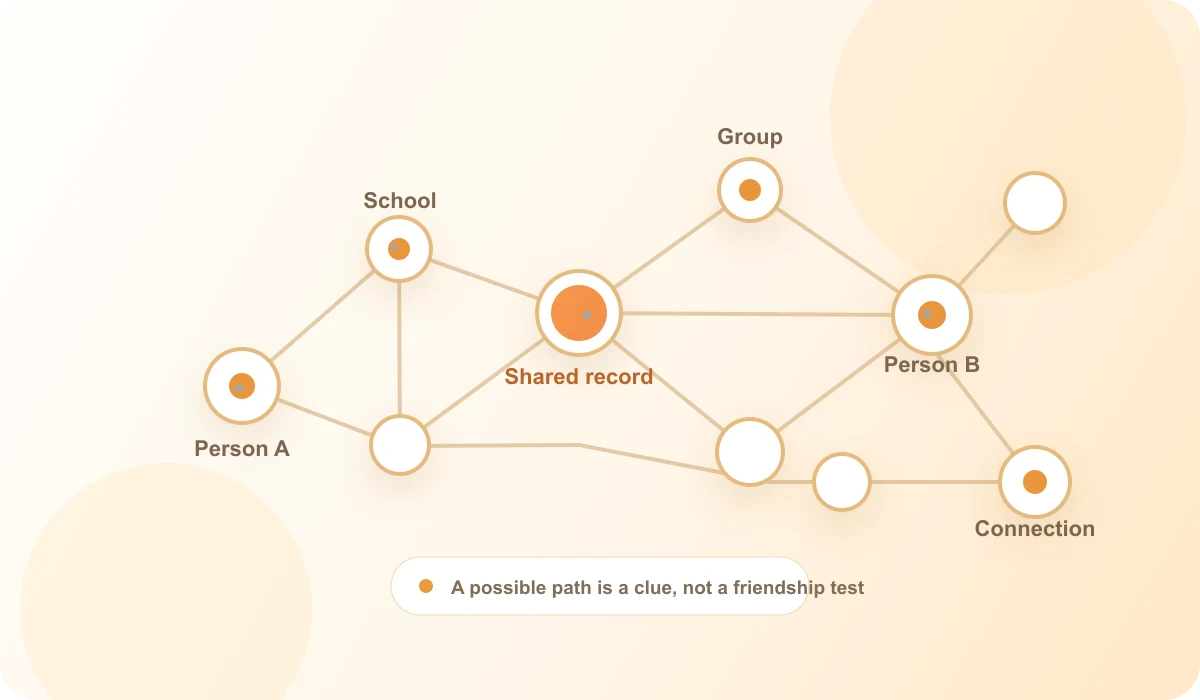
How Far Rouge is a browser-based people-connection explorer, also presented in Korean as 몇 다리. It answers a narrow entertainment question: how many recorded steps might connect one selected public figure to another? Rather than measuring personal closeness, it searches a graph of people and shared affiliations such as schools, employers, organizations, and entertainment credits.
The original interface groups its experience into person-to-person, self-to-person, and self-friend-person modes. This ToolAtrium page recreates that simple flow in English and Korean and sends searches through a same-site endpoint. You can try the interactive lookup above without leaving ToolAtrium. Search availability and graph coverage depend on the upstream data service.
Person → person
A path between two public profiles
Me → person
From an affiliation to a public profile
Me · friend · person
Join two public-profile searches
How to read the number of links
A result such as “two links apart” describes the number of edges in the returned path, not a scientifically measured social distance. Each edge is attached to a visible relationship label and a review status when the service supplies one. An alumni label may point to a shared university record; an organization label may come from a company or group association.
Read the chain itself, not only its number. A short route can be less convincing than a longer route if one of its records is unverified or its dates do not overlap. The graph can suggest where a relationship came from, but it cannot tell you whether two people personally met. This distinction is central to using the How Far Rouge test responsibly.
Three ways to explore a connection
Person to person compares two public profiles directly. Use it for a quick celebrity-to-celebrity search, then inspect every hop. Me to a person lets you start from a selected public affiliation such as a school or company and search toward a public figure; it does not require you to enter your name. Me · friend · person joins two profile lookups so you can explore a possible chain through a friend who has a public profile.
These modes answer different questions. The affiliation mode is useful when you want to explore a shared public institution without disclosing your identity. The friend route is only a stitched pair of graph results; it does not validate an introduction, private acquaintance, or the friend’s consent. For any mode, select profiles carefully and do not treat the path as evidence of endorsement or friendship.
Example: SUGA and IU
During a live check on November 12, 2026, a search for SUGA of BTS and singer IU returned a two-link route through WOODZ. The first displayed edge was a Global Cyber University alumni label with a reviewed status. The next was a same-agency label marked unverified, with dates not established in the result. That output demonstrates how a connection graph can produce a short path while still containing a weak edge.
The example is a dated observation, not a permanent result and not proof that the artists know each other. The source graph may change, and future searches can return a different route or no route at all. A useful How Far Rouge result is one you can inspect link by link, including uncertainty, rather than a number you repeat without context.
Who may find it useful?
The tool suits fans comparing public biographies, people curious about how professional or educational networks overlap, and writers looking for a starting point for further verification. It can also be a light conversation prompt for a group that understands the difference between public records and personal relationships.
For reflection about your own personality, try ToolAtrium’s Unlock Personality quiz. For a structured look at relationship patterns, see the relationship dependency test. Korean readers who want a social prediction mini-game can continue to The King’s Warden 2. These internal guides explore adjacent topics; none validate a connection returned by How Far Rouge.
Privacy, evidence, and responsible sharing
The person and affiliation search fields send the text you type to the connection service so it can suggest matches. Use searches for public figures and public institutions only. Do not type a private person’s name, school, employer, or other identifying details into this page. The self mode does not transmit a typed name: it sends only the selected public destination and affiliation IDs.
A path can be missing because the graph does not contain enough links, not because two people have no connection. Records may use inconsistent spellings, combine periods, or rely on claims that have not been checked. The service can also be temporarily unavailable. If a label matters, verify it independently before publishing it. Avoid presenting an inferred path as fact about a person’s private life, and do not use this entertainment tool for hiring, eligibility, safety, or other consequential decisions.
Data and limits
How Far Rouge presents a changing graph assembled from public knowledge sources and community-reviewed records. ToolAtrium displays only the people, link labels, and review status returned for this query; source links and raw records are not shown here. The upstream page displayed a data date of August 29, 2026 when reviewed. Some records can be incomplete, disputed, or stale.
The source service attributes its data to Wikidata, Wikimedia Commons, TMDB, and NamuWiki and labels the collection CC BY-NC-SA for non-commercial use. This page does not reproduce profile photos or long source text. Names and concise relationship labels are shown only as returned by the search.